Showing posts with label Fibonacci numbers. Show all posts
Showing posts with label Fibonacci numbers. Show all posts
Wednesday, May 8, 2013
Fibonacci Day... or is it?
We've discussed the Fibonacci sequence previously on this blog. You can click on this link to read the earlier posts. All we need remember right now are the numbers themselves
0, 1, 1, 2, 3, 5, 8, 13, 21, 34, ....
The rule is that the next Fibonacci number can be created by adding up the two previous numbers.
Today is May 8, 2013, which is often written as 5-8-13, which means this is a Fibonacci day and the next one would be 8-13-21. Since there aren't 13 months in the year, that will be the last Fibonacci day this century.
But consider this. In the United States, we state a date in the form Month-Day-Year. It seems natural enough since most of us have done this all our lives, but note that the order in size is middle-small-big. It might be more natural to state it in the form Day-Month-Year, which would be small-middle-big. If we do that, today's date is the 8th day of the 5th month of the 13th year or 8-5-13. Using that method, this year's Fibonacci day would be the 5th of August, not the 8th of May.
Side note: when it comes to time measured on a smaller scale, the whole world agrees to go from the largest unit to the smallest, hours:minutes:seconds:fractions of seconds. If we agreed to that way with the larger time units, this moment should be 2013 May 8 7:35 PM.

Friday, January 11, 2013
Fibonacci numbers and phi, the golden mean.
The Fibonacci sequence is created by adding things together, which makes it an arithmetic sequence. In this usage of the word, it is pronounced ar-ith-ME-tic instead of ar-ITH-me-tic.
A sequence created by multiplying things together is called a geometric sequence, pronounced exactly as you would expect. For example, the powers of two are geometric.
1
1 × 2 = 2
2 × 2 = 4
4 × 2 = 8
8 × 2 = 16
...
If the Fibonacci sequence was geometric, you would see a clear and simple pattern when you divided a Fibonacci number by the next one in the sequence, but this pattern is neither clear or simple.
1/1 = 1
2/1 = 2
3/2 = 1.5
5/3 = 1.666666...
8/5 = 1.6
11/8 = 1.625
...
Obviously, the numbers change each time. Not quite as obviously, there is a pattern called an alternating sequence. 2 > 1, but 1.5 < 2. The sequence gets bigger, then smaller, then bigger, then smaller, ad infinitum. More than that the small numbers (1, 1.5, 1.6...) are growing and the big numbers (2, 1.666..., 1.625) are shrinking. This means the two sequences are converging. In this particular case, they are converging towards a number called phi (pronounced 'fee'), which is also known as the Golden Ratio, which can be expressed by the algebraic number (1 + sqrt(5))/2, which is approximately 1.61803...


This spiral is based on the Fibonacci sequence. As it gets bigger and more squares with quarter circles are added, it gets to look more and more like the Golden Spiral, but it does not shrink indefinitely, starting with squares of size 1 ×1, 1 ×1, 2 × 2, 3 × 3, 5 × 5, etc. When I teach this method, I call it the Gold Plated Spiral, but that is not a generally used name.
Tomorrow: Perfect squares and sums of odd numbers.
Thursday, January 10, 2013
Fibonacci numbers in nature.
In yesterday's post, I discussed the Fibonacci sequence, the infinite number sequence that starts
0, 1, 1, 2, 3, 5, 8, 13, 21, 34, 55, 89, 144...
A sequence that generates the next number in the line by adding together the two numbers just before it. Leonardo of Pisa introduced the numbers in a completely whimsical problem allegedly based on the reproduction cycles of rabbits.
It sometimes happens in math that a tool needed to solve a problem will already exist, built to work on another earlier problem that was often created just for the sake of the beauty of it. So it is with the Fibonacci sequence.
We are often shown cell growth as a constant splitting process, the number of cells doubling each time a new splitting occurs. This is not always the case, as some cells split unequally, one of the new cells getting all the materials needed to replicate at the next splitting time while the second cell does not have what it takes and instead has to use that time period to grow into a ready cell. Here is an example.
Step 1: Cell splits into ready and unready. (2 cells)
Step 2: Ready splits into ready and unready. The earlier unready grows into ready. (3 cells)
Step 3: The two ready cells split, creating two ready cells and two unready cells. The one unready cell from Step 2 grows into ready. (5 cells, 3 ready, 2 unready.)
...
This kind of growth pattern is seen in many plants. Many flowers naturally grow a Fibonacci number of petals, notably 5, 8, 13 or 21.

This top down view of a pine cone shows the number of spirals emanating from the central point. The number of clockwise spirals is 13, but when counting the counter-clockwise, the pattern is not as tight and the number is only 8. With most browsers, this picture animates to show the two counts. If it doesn't work here, try clicking on this link to go to the original.
Tomorrow, the Fibonacci numbers and the Golden Ratio.
Wednesday, January 9, 2013
Fibonacci numbers
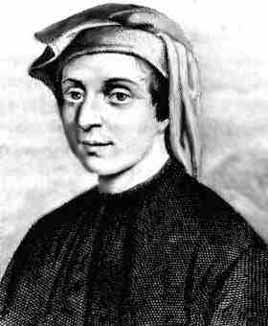
Leonardo of Pisa, known more commonly as Fibonacci, was born in about 1170 and died in 1240. He is considered the greatest mathematician of the Middle Ages in Europe. He greatest lasting contribution is his book Liber Abaci, where he recommended the use of the number system he called The Arab numerals (now known as Hindu-Arabic numbers, the ones we use today) instead of the Roman numerals still used in Europe in his day. But his name survives because of a math puzzle he created, and the series of numbers that answer the puzzle are still called the Fibonacci numbers.
The puzzle went as follows. You have a pair of rabbits. Their breeding cycle is one month. The original pair gives birth to a new pair. The newborn rabbits are too young to breed, but the original pair will produce another pair of rabbits in the next month and the newborn will grow to maturity in a month so they will start breeding. How many pair of rabbits will you have in a year?
Of course, rabbits don't actually breed this way, but let's solve the problem anyway
Beginning of January: 1 pair
Beginning of February: 2 pairs, only 1 fertile
Beginning of March: 3 pairs, only 2 fertile
Beginning of April: 5 pairs, 3 fertile
Beginning of May: 8 pairs, 5 fertile
Beginning of June: 13 pairs, 8 fertile
Beginning of July: 21 pairs, 13 fertile
Beginning of August: 34 pairs, 21 fertile
Beginning of September: 55 pairs, 34 fertile
Beginning of October: 89 pairs, 55 fertile
Beginning of November: 144 pairs, 89 fertile
Beginning of December: 233 pairs, 144 fertile
Beginning of next January: 377 pairs, 233 fertile
This is the beginning of the sequence called the Fibonacci numbers. As you can see, the number of fertile rabbits follows the same pattern as the number of rabbits, just a month behind.
The rule that creates the Fibonacci numbers: The next Fibonacci number is always the sum of the previous two Fibonacci numbers.
The modern way to count them: In number theory today, instead of starting with 1 and 2, the Fibonacci sequence starts with 0 and 1. We can write them this way.
f0 = 0
f1 = 1
f2 = 0+1 = 1
f3 = 1+1 = 2
f4 = 1+2 = 3
f5 = 2+3 = 5
f6 = 3+5 = 8
...
When speaking, I would say "f 6 equals 8" or "the sixth Fibonacci number is 8". There are some interesting number theory patterns in the sequence dealing with divisibility.
Rule: Any two consecutive positive Fibonacci numbers are relatively prime.
Rule: The fifth Fibonacci number is 5, and every fifth number in the sequence is divisible by 5.
f10 = 55 and f15 = 233 + 377 = 610. To test it out for yourself, continue the pattern to find f20 and f25.
The answers are in the comments.
Tomorrow: The Fibonacci sequence shows up in nature.
Subscribe to:
Posts (Atom)